
In the summer of 2026, hundreds of millions of people worldwide experienced the hottest days of their lives — so far.
From June to August, the U.S. endured record-setting average temperatures. More than 16,000 people died in Europe over a single week amid a heat wave that pushed above 100 degrees Fahrenheit. Worldwide, more than 1.5 billion people were exposed to dangerous levels of heat throughout the summer season.
Chart these highs against historical data, and it’s clear they aren’t outliers. This is life on a warming planet.
More than 1 billion people worldwide lack adequate cooling, which is now a necessity rather than a luxury. Experts predict rising demand will lead to the installation of three billion more air conditioners (ACs) over the next few decades. Yet today’s energy-guzzling models are already straining electrical grids and raising monthly bills for families around the world. Installing more of them will bring more planet-warming pollution, pushing temperatures higher still.
Clean Cooling Collaborative (CCC), a global effort focused on scaling energy-efficient, climate-friendly cooling methods, is finding ways to keep people safe and cool without tipping the world into a self-reinforcing cycle of runaway warming.
“Our work is about so much more than just counting carbon or reducing emissions,” Noah Horowitz, Clean Cooling Collaborative’s senior director, said. “It’s about making it easier for people to sleep, study, and work. It’s about saving lives. It’s also about taking stress off the grid and preventing power outages and lowering people’s utility bills.”
From Montreal to Kigali to clean cooling
Clean Cooling Collaborative’s story begins in 2016, with the Kigali Amendment to the Montreal Protocol — an expansion of one of history’s most successful examples of international cooperation.
Adopted in 1987, the Montreal Protocol phased out the chemicals eating away at the ozone layer, which shields people and nature from the sun’s harmful ultraviolet rays. But the most common replacement at the time, hydrofluorocarbons (HFCs), carried a hidden cost: while sparing the ozone layer, they trap hundreds to thousands of times more heat than carbon dioxide. The Kigali Amendment would phase down HFCs and speed a shift to climate-friendly alternatives.
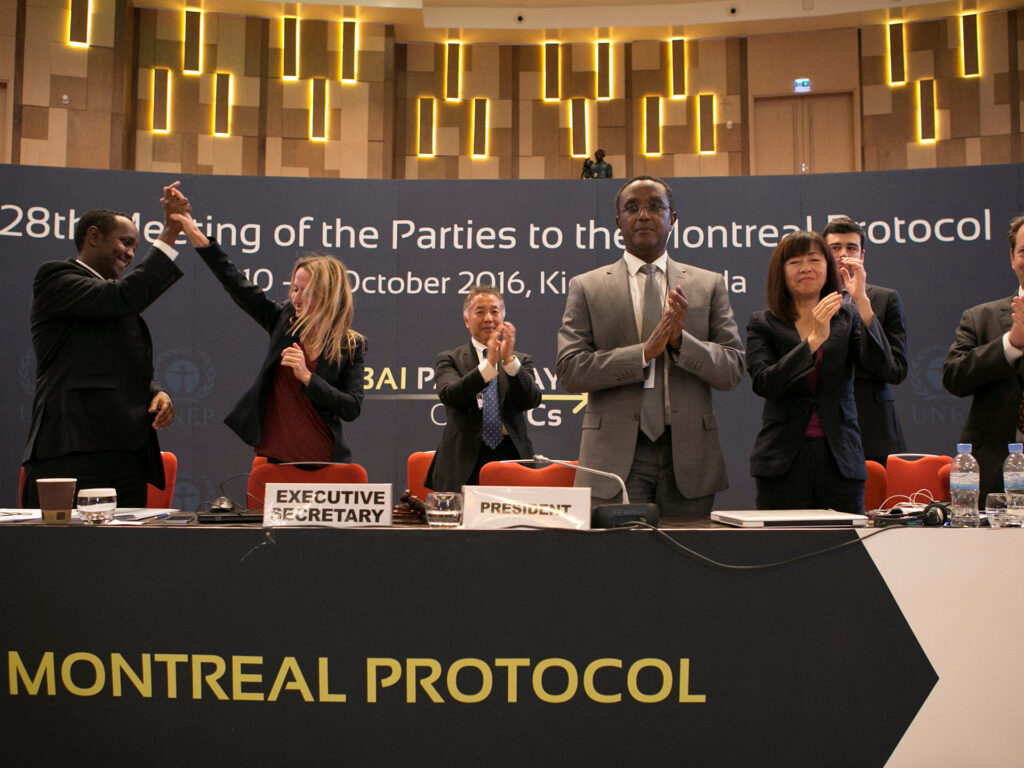
But the Kigali Amendment faced one big obstacle: emerging economies lacked the investment and technical assistance to meet its targets. The Hewlett Foundation and other funders stepped in, mobilizing a $53 million commitment from the philanthropic community. It’s one among many examples of work the Hewlett Foundation has made possible over the last two decades through collaborative climate philanthropy, acting as a first mover and working together with other philanthropies to spur innovations that address real community needs.
The fund launched as the Kigali Cooling Efficiency Program, helping countries pair their HFC transitions with gains in energy efficiency. But within a few years, the team realized they faced a much bigger challenge: the widening gap between the growing need for cooling in a warming world and the availability of sustainable ways to meet it.
In 2021, the program broadened its mission and relaunched as the Clean Cooling Collaborative, setting an ambitious target: averting 100 gigatons of carbon pollution from cooling by 2050. That’s roughly equal to the total emissions produced by the U.S. between 1990 and 2010. Today, it works to make cooling — from fans and ACs to solar-reflective “cool roofs” — more sustainable, affordable, and accessible around the world.
Working alongside innovators, policymakers, and businesses
Cooling is a complex challenge. Climates and risks vary by region. Some technologies perform best only with particular building designs. And with the average wage in the Global South below $2 an hour, many people may struggle to afford newer, more energy-efficient appliances or home retrofits.
That’s why Clean Cooling Collaborative is taking a “silver buckshot” approach to transforming how the world cools off. Rather than relying on a single solution, its grantees are advancing a wide range of potential remedies through a mix of standards and regulations, technology deployment, and creative financing.
Clean Cooling Collaborative has built a broad ecosystem of 35 grantees worldwide, ranging from international nonprofits and cooling experts to hyperlocal groups. While its grantmaking concentrates on Asia, CCC grantees aim to foster engagement across a global community of clean cooling advocates — so that local stakeholders in Asia, Africa, or Latin America can learn about best practices and implement the most promising breakthroughs pioneered elsewhere in the world.
A sprint to change cooling
Nowhere is Clean Cooling Collaborative’s approach clearer than in the race to reinvent the air conditioner itself.
In CCC-funded field tests, super-efficient prototypes have used 60% less energy than the units on the market today — progress toward the goal of next-generation air conditioners that are up to 80% less carbon-intensive. CCC grantees are providing technical assistance to multiple manufacturers working on technology that can both lower temperatures and reduce humidity. Now they are seeking partnerships with big buyers of ACs like sustainability-focused housing developers, whose large orders can give manufacturers the demand signals they need to get these units off the test bench and into homes.
“Over the last five years, the biggest cooling companies have been competing to develop next-generation air conditioning technology. They are well on their way,” Anup Bandivadekar, a program officer for Hewlett’s Environment Program, whose portfolio includes CCC, noted. “This is the kind of climate-friendly advancement that will help ensure people can run their AC in a heat wave without having to worry about whether they can afford the bill. Clean Cooling Collaborative made it possible by bringing together technical and policy experts to run real-world testing and help build the market.”
Better machines are only part of the picture. With support from the Clean Cooling Collaborative, its grantees have helped 10 countries adopt stronger minimum energy performance standards for cooling products ranging from room ACs to refrigerators, using guidelines developed by its grantees. Regional grantees like the Southern African Development Community and the Association of Southeast Asian Nations are using the guidelines to set regional and national standards.
CCC grantees provided technical analysis that helped inform China’s adoption of stronger performance standards for room AC units, which transformed the global room AC market almost overnight, shifting two-thirds of sales away from inefficient “fixed speed” models in favor of “inverters.” Inverters can cut annual energy use by up to 30%, making it cheaper to cool homes, offices, and shops around the world.
As these innovations prove themselves, CCC grantees work directly with key stakeholders to speed their adoption. In nine countries, cooling is now part of climate action plans, and 71 governments have joined the Global Cooling Pledge, a commitment to reduce global cooling-related pollution by 68% by 2050. Many governments see an economic upside, as higher-efficiency air conditioning and fan designs drive investment in manufacturing alongside demand for contractors who can install and maintain new equipment.
Design for the future
CCC is also improving how people live through building design approaches known as “passive cooling”, which keep indoor spaces cooler and reduce the reliance on air conditioning. Take “cool roofs,” which use reflective materials to bounce much of the sun’s energy away from a building rather than absorb it as heat. CCC grantees in Indonesia have deployed over 76,000 square meters of cool roofs and more than 100 reflective “cool houses” across the country.
They’re collaborating with an Indonesian metal manufacturer to mass-produce “cool panels” for roofs and walls of homes and businesses across the country. Local champions, ranging from residents and business owners in low-income communities to university students and faculty members, meanwhile, have sparked discussions among Indonesian officials about creating housing subsidies to make cool roofs affordable for households of all income levels.
Progress on a long road
Clean Cooling Collaborative’s efforts have already locked in 10 gigatons of avoided carbon pollution by 2050 — the equivalent of removing the annual emissions from 3.1 billion gas-powered cars.
“The market’s shift to inverters has been amazing. And we are confident the technology behind the next-generation AC units will be ready for the market soon. Perhaps most importantly, the need for these clean cooling solutions is now understood across the international community,” Horowitz observed.
But as temperatures tick up year by year, the urgency of this work is only growing.
Building on its work in Indonesia, the CCC team sees cool roofs as a practical entry point to build momentum for passive cooling. They have launched a new initiative called Million Cool Roofs Collective to scale cool roofs in key markets in Southeast Asia. They also see gaps in planning for retiring older ACs and where policies can ensure the HFCs in those units are safely captured and disposed of. “You need long-term, stable support to get any of this done, and that’s what Hewlett has provided since this program’s inception,” Horowitz explained.
“It’s remarkable to think about the collective impact that the Clean Cooling Collaborative program has already made by pushing forward so many brilliant solutions to the cooling challenge — lives saved, cost burdens lowered, health outcomes raised, carbon avoided,” Bandivadekar said. “That’s the power of patient philanthropic capital.”